KPV
/K · P · V/aka Lys-Pro-Val, α-MSH (11–13), Alpha-MSH C-terminal tripeptide
The last three amino acids of the hormone alpha-MSH, which calm inflammatory signaling in gut-lining cells and in mouse colitis models.
KPV: educational research discussion. Not medical advice. Not a protocol for you.Details
- Reported range
- 200–500 mcg daily (SC)
- Frequency
- Once daily (reported)
- Cycle length
- 4–8 weeks on (reported)
- Half-life
- Unknown in humans
- Route
- Oral or SC
Reported figures describe what is published or discussed. None of them is a dose for you.
Mechanism
What it is proposed to do
KPV is residues 11–13 of alpha-melanocyte-stimulating hormone (α-MSH), a hormone with broad anti-inflammatory effects. It lacks the His-Phe-Arg-Trp core that α-MSH uses to activate melanocortin receptors. In gut-lining cells, KPV is carried inside by the PepT1 peptide transporter and reduces NF-κB and MAP kinase signaling, lowering inflammatory cytokine release. Mice with chemically induced colitis given oral KPV had less inflammation. Which receptor or target mediates this, and whether any of it happens in people, is unsettled.
- 01
KPV
Lys-Pro-Val; the last three residues of α-MSH
established - 02
PepT1 uptake
Carried into gut-lining cells in cell and mouse studies
proposed - 03
NF-κB · MAPK ↓
Lower inflammatory cytokine signaling in cells
proposed - 04
Less colitis in mice
Chemically induced (DSS, TNBS) colitis models
proposed
Half-life. Unknown in humans. No published human pharmacokinetic data.
Dosing & cycles
What is reported, and where it comes from
Numbers below are labeled FDA label, clinical trial range or commonly reported range. They describe the published and discussed landscape. They are not instructions and not a protocol for you.
Dosing studio
Every figure is labeled by where it comes from.
Scale view: Commonly reported injectable range
Probe at 350 mcg: inside the reported band (200–500 mcg). Drag it to read the scale. It does not pick a number for you.
Typical cycle, as a calendar
Commonly reported daily block
4–8 weeks on, then a break
Dosing guides describe daily use for 4–8 weeks, then time off. No pattern has been tested in people, so the shape here is illustrative only.
Cycle patterns
Commonly reported daily block
Dosing guides describe daily use for 4–8 weeks, then time off. No pattern has been tested in people, so the shape here is illustrative only.
Stacks
What it gets combined with
Why people pair things, and what nobody has tested.
Gut repair pairing
2 compounds- Why people combine these
- Both are discussed for gut inflammation: BPC-157 for its rodent GI-healing data, KPV for its mouse colitis data.
- Caution
- Two compounds with no completed human efficacy trials. Gut symptoms serious enough to prompt this are serious enough for a gastroenterologist.
- What is unknown
- No published human data on this combination: dosing, interactions and long-term effects are all unstudied.
Also sold in pre-mixed blends
What a blend changesIn a blend, KPV cannot be adjusted on its own, and the mixture has no human data of its own. Typical vial formats shown; labels vary.
Evidence
How much of this is known
Evidence grade
D
Little useful signal
Mechanism speculation, marketing, or almost no useful human signal.
How we gradeCoherent cell and mouse work from a small number of groups. No completed human efficacy data, so the grade is D however clean the mouse results look.
Human trial status
No completed human efficacy trial that we could verify as of September 2026. The case rests on cell work and mouse colitis models: KPV given in drinking water reduced DSS- and TNBS-induced colitis (Dalmasso et al., Gastroenterology 2008), and KPV loaded into colon-targeted nanoparticles reduced colitis in mice (Laroui et al., Gastroenterology 2010).
Limitations
- No human pharmacokinetic, safety or efficacy data.
- Chemically induced mouse colitis does not fully mirror human inflammatory bowel disease.
- Much of the gut work comes from one laboratory group.
- FDA staff told the 2026 advisory committee that KPV was not well characterized.
Sources to read
- Dalmasso G et al. PepT1-mediated tripeptide KPV uptake reduces intestinal inflammation (Gastroenterology 2008)
- Laroui H et al. Drug-loaded nanoparticles targeted to the colon with polysaccharide hydrogel reduce colitis in a mouse model (Gastroenterology 2010)
- Kannengiesser K et al. Melanocortin-derived tripeptide KPV has anti-inflammatory potential in murine models of inflammatory bowel disease (Inflamm Bowel Dis 2008)
- FDA Pharmacy Compounding Advisory Committee, July 23–24, 2026
Links open PubMed, DailyMed, FDA or trial-registry searches. We do not cite what we have not described accurately.
Safety
Side effects, cautions, status
Commonly reported effects
- No human safety dataset exists. Absence of reported harm reflects absence of study.
- Injected use carries the usual injection-site, sterility and endotoxin risks of gray-market vials.
- Undiagnosed gut symptoms (bleeding, weight loss, persistent diarrhea) need a diagnosis before anyone reaches for a peptide.
- Product identity and purity are unverified between sources.
Who should be extra cautious
- Inflammatory bowel disease. Mouse colitis data are the entire rationale. Proven IBD treatments exist, and KPV has not been compared with any of them.
- Immunosuppressed or on biologics. Adding anti-inflammatory signaling on top of immune-modifying drugs has not been studied.
- Pregnancy or breastfeeding. No data at all.
- Tested athletes. Prohibited at all times as a non-approved substance (WADA S0).
- Gray-market product. Identity, purity and endotoxin are unverified.
Legal & regulatory status
Not approved as a drug anywhere. FDA removed KPV from its Category 2 compounding-risk list in April 2026. In July 2026 an FDA advisory committee voted 8–6 (1 abstention) to recommend it for the 503A bulks list, against FDA staff advice. Until FDA finishes rulemaking, that is a recommendation, not permission to compound.
2026 compounding context. July 23–24, 2026: FDA's Pharmacy Compounding Advisory Committee recommended KPV for the 503A bulks list 8–6 with 1 abstention. FDA staff had recommended against, saying KPV was not well characterized and human safety and effectiveness data were insufficient. Legal compounding requires a final FDA rule.
WADA. Not named individually, but as a substance with no human therapeutic approval it falls under S0 (non-approved substances), prohibited at all times.
Storage & handling, high level
Sold as powder, sometimes as capsules. Reconstituted peptides are generally kept refrigerated, away from light, and degrade over weeks. We found no published stability data for oral products.
Reconstitution and injection technique are clinical skills. The reconstitution calculator does arithmetic only.
FAQ
Questions people ask about KPV
What is KPV?
Has it been tested in people?
Is KPV legal to compound now?
Oral or injected?
The monthly Evidence Brief
Keep up with the evidence
One email a month: new trials, grade changes and FDA or WADA updates across the whole atlas, KPV included. You get the free guide right away.
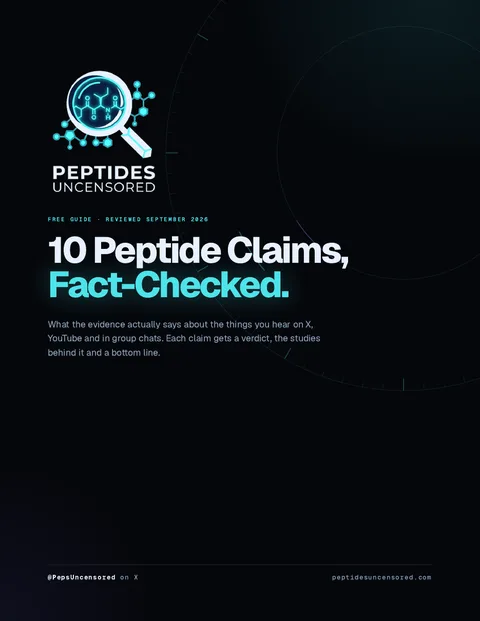
Free guide · PDF
10 Peptide Claims, Fact-Checked
13 pages · sent to your inbox right away
Email only. Unsubscribe from any email in one click. We do not sell or rent your address. Nothing we send is medical advice. Privacy